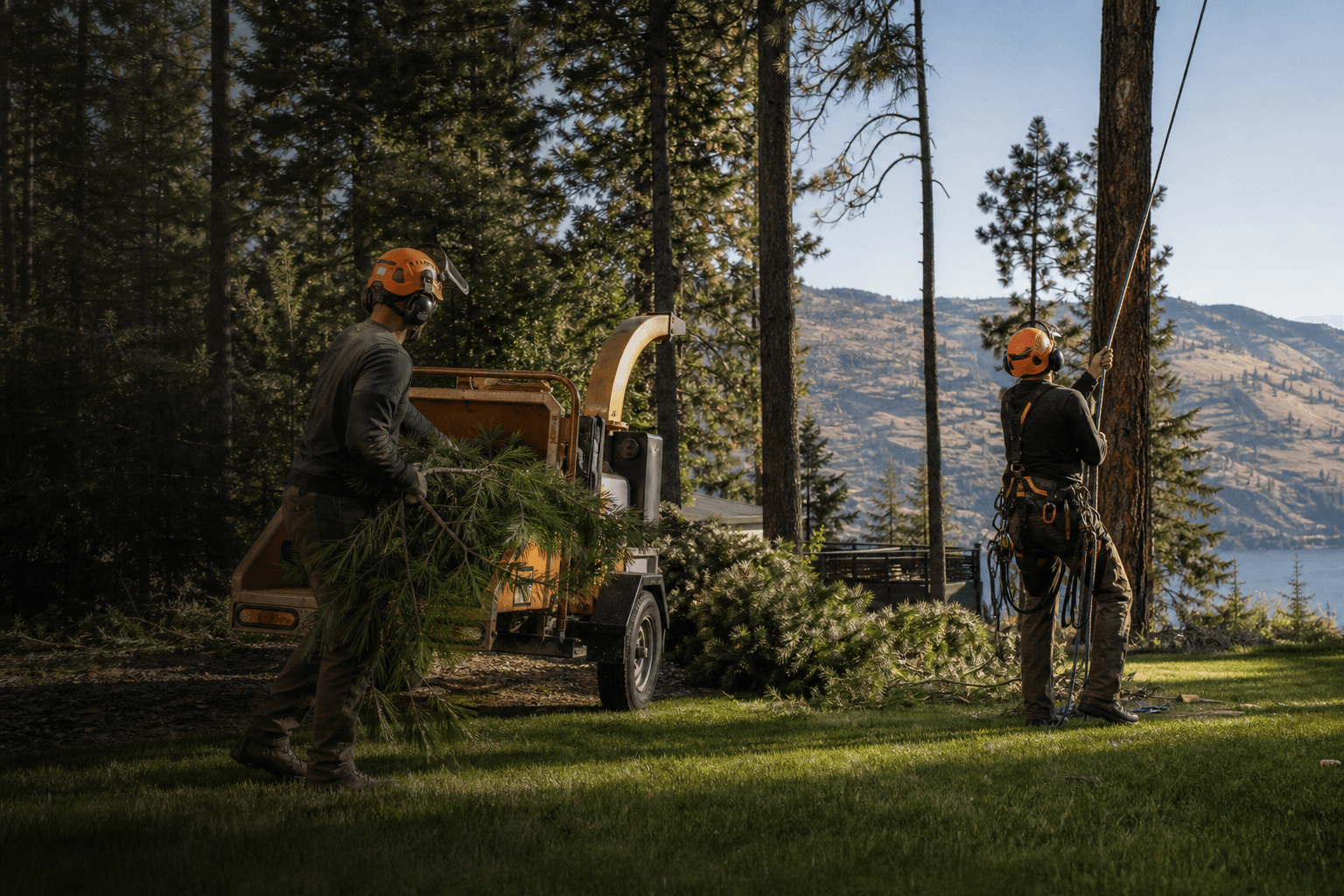
The Okanagan has lived through enough wildfire seasons that nobody here needs convincing the risk is real. The McDougall Creek fire in West Kelowna in 2023 brought it right to people's doorsteps. The good news is that the trees and vegetation around your home are one of the few wildfire factors you actually control. Managing them well, what's called creating defensible space, genuinely improves your home's odds. This guide explains how.
How wildfire reaches a home
Homes ignite during wildfires in three main ways: direct flame contact, radiant heat from nearby burning fuel, and, most commonly, embers. Wind-driven embers can travel well ahead of a fire front and land in dry debris on or around your house. Tree and vegetation management targets all three by reducing the fuel close to the home and breaking up the path a fire would take to reach it.
The zones of defensible space
FireSmart thinks about your property in zones radiating out from the house. The closer to the home, the more important the work.
- The immediate zone (right around the house): this is the highest priority. Keep it as free of flammable material as possible. No trees or shrubs tight against the walls, no firewood stacked against the house, clean gutters and roof.
- The intermediate zone (out to roughly 10 metres): thin trees so the canopies aren't touching, limb them up off the ground, remove deadwood, and keep grass and shrubs low and well spaced.
- The extended zone (beyond that): thin dense stands, remove ladder fuels, and clean up dead and down material so a fire moving through has less to feed on as it approaches.
The tree work that makes the biggest difference
Within those zones, a few specific jobs do most of the work of reducing risk.
- 1Limb up the trees. Removing the lower branches creates a gap between the ground and the canopy so a grass or surface fire can't 'ladder' up into the treetops.
- 2Break up the ladder fuels. Clear the shrubs, small trees, and dead branches that bridge a ground fire up into the big trees. This is some of the most important work there is.
- 3Thin dense stands. Trees with canopies touching let fire jump tree to tree. Spacing them out slows or stops that.
- 4Remove dead trees and deadwood. Standing dead trees and accumulated deadwood are easy, intense fuel close to the home.
- 5Clean up the debris. Cut material left on the ground is just new fuel. It has to be chipped or hauled away to count.
You don't have to clear-cut your yard
A common worry is that FireSmart means cutting down all your trees. It doesn't. Healthy, well-spaced, limbed-up trees are part of a fire-resilient property, and they provide the shade that's so valuable in our hot summers. The goal is reducing and breaking up fuel, not levelling everything. A good crew targets the real hazards and leaves you with a property that's both safer and still pleasant to live on.
When to do it
Spring and early summer, before fire season ramps up, is the ideal time. It also means the cut material can be dealt with before any fire restrictions limit what you can do with it. If you're on the wildland interface anywhere in the valley, this is worth getting on the calendar early.
We do FireSmart fuel reduction across the fire-prone hillsides of West Kelowna, Peachland, and throughout the Okanagan. We'll walk your property, flag the real risks, and tell you what makes the biggest difference. Free assessments, no pressure.